
Plan Your Visit
What to expect when visiting
Parking
Street parking is available along Termino Ave. and Colorado St. Our parish is ADA accessible from the street, to the sidewalk, and into the sanctuary with an easy to access ADA ramp on the Colorado side of our parish.
Entering the Building
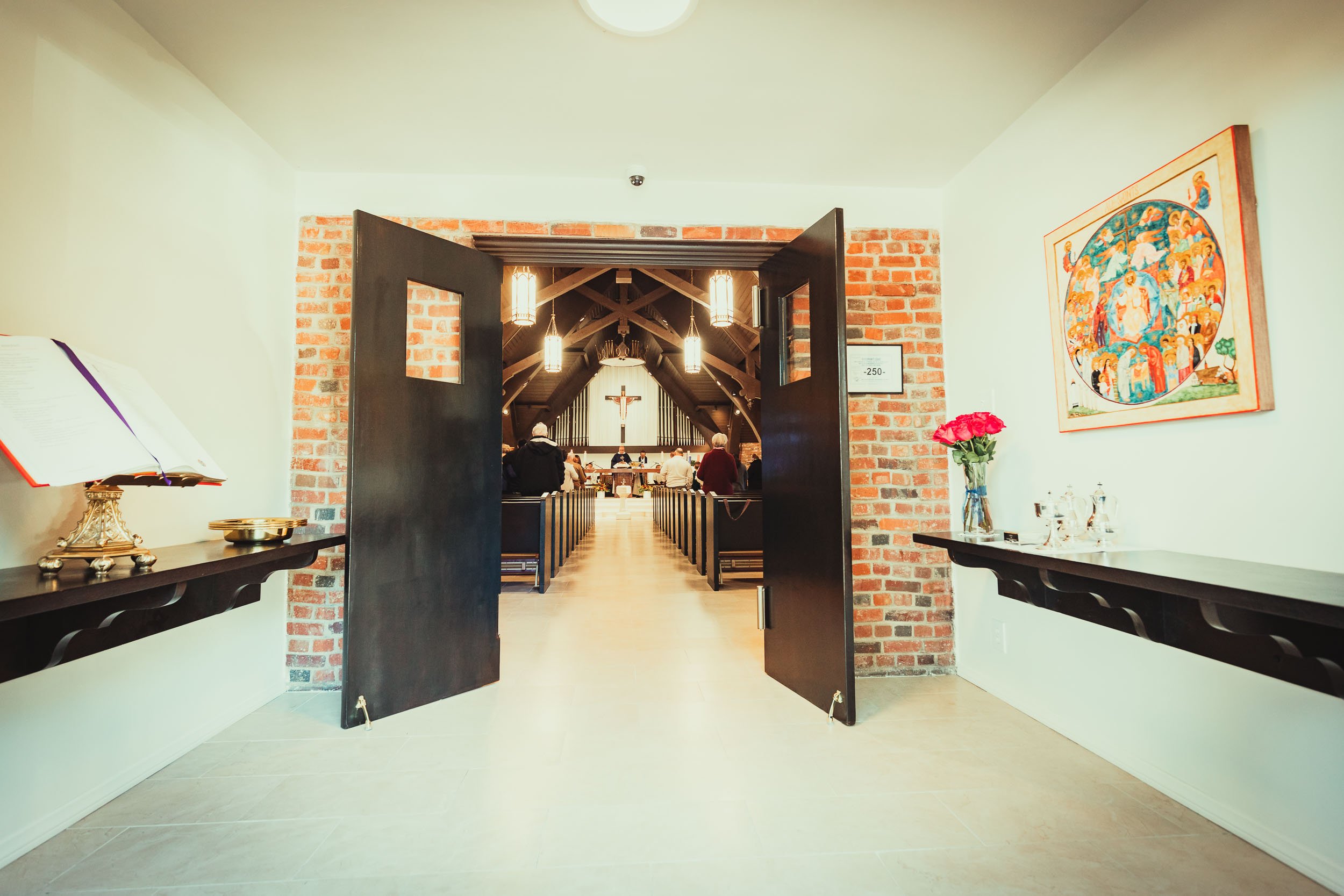
Approaching the parish from Termino Ave., guests can proceed through the front red doors to enter our sanctuary. Those requiring a ramp for entrance are welcome to approach from the Colorado St. side of the building through the door to St. Mary’s Chapel.
Our Services
Visiting a church can feel unfamiliar. We want to make your first Sunday as simple and welcoming as possible. Come as you are, and do not worry if the service or Anglican patterns are new to you. Our worship booklet will guide you, and the people around you will be glad to help.
We gather on Sundays for The Holy Eucharist at 8:00 a.m. (contemplative and spoken with no music) and 10:30 a.m. (variety of ages, choir when in season, and music in the service), with formation and discipleship opportunities between services. View our current service schedule and seasonal observances before your visit.
Children
Children are not simply the future of the Church; they are part of the Church now! We offer warm, safe, and joyful spaces where children can encounter God’s love through care, play, prayer, and the stories of faith.
We love having children in worship. Jesus said, “Let the children come to me” (Matthew 19:4). Their voices and movements are part of our life together. If your child becomes distressed, please step out briefly and return when ready - this helps everyone share in the gift of communal worship. Family Ministries joyfully provide children’s classes at the 10:30 a.m. service. Ages 1-6: drop off in the Children’s Wing starting at 10 a.m. Parents pick up children during the Peace (between the Ministry of the Word and Ministry of Holy Communion) so families can be together for Communion. Grades 1-5: after the opening part of the service, children are invited to the front to receive a blessing and go out for a homily, returning at the Peace. On fifth Sundays on the month, all children general worship with parents.
Our Location
Our Parish is located at 346 Termino Avenue, Long Beach, CA 90814

About our Worship
Our worship is biblical, sacramental, historic, and liturgical (participatory). We hear God’s Word read and proclaimed, confess our sins, proclaim the historic faith, pray together, receive Holy Communion, and are sent into the world to love and serve Christ and all people whom Christ loves. You are welcome to participate as you are comfortable and to speak with a priest if you have questions about receiving Communion.
For thousands of years, God's people have been coming together on one day of the week to worship. And despite their great diversity across time and space, the worship itself has remained remarkably similar. In fact, most Christians, both throughout history and alive today, practice a common form of worship. It's called liturgical worship.
Liturgy is a Greek word that technically means the work of the people. Simply put, liturgical worship is worship characterized by the work of the people involved. So, liturgical worship is not entertainment, nor is it performed by some on behalf of others. It's the way a community worships as one. It follows a simple pattern. First, we're gathered by God. Then, we hear His word. Share in Thanksgiving. Finally, we're sent back out into His world. Each of these four movements contains distinct elements that aren't uniformly practiced. The movements themselves, however, are nearly universal. We'll look at each.
First, the gathering. Christian worship begins with the call of God's grace. We leave the isolation of our individual lives and gather together as a local expression of Christ's body. The first movement includes elements like mutual greetings, an opening song, prayer. On the surface, it looks like a simple and predictable way to begin the service. But consider the story our liturgical actions point toward. For example, many churches begin their worship with a literal procession of participating clergy and volunteers who follow a cross. The procession is representative of all God's people assembling to worship. And its position behind the cross is a reminder that it's only Christ's death that makes it possible for us to offer pleasing and acceptable worship. That it's only in Christ that we would be so bold as to march into the presence of God. A final element often featured in the gathering is a prayer for that particular Sunday. Anglican Christians, for example, often use collects, an ancient, delicately structured prayer form that collects the concerns of the assembled congregation. Anglican Christians, for example, often use collects, an ancient, delicately structured prayer form that collects the concerns of the assembled congregation.
Being gathered by God, we're ready to enter the second movement of liturgical worship, hearing the word of God. It begins with God's word, read and proclaimed. Liturgical worship often features up to three readings of scripture. Ordinarily, the first reading is from the Old Testament. The second reading is often from a letter in the New Testament. A hymn might then be included as a response to the readings thus far and as a preparation for the gospel reading. As we hear the stories of Jesus' ministry, we experience the living Christ speaking to us through his word. We might even stand for the reading as a way to honor the importance of these stories to our faith. We explore the meaning of these readings in the sermon. The preacher's goal is to both interpret these selected texts and make the gospel the good news of God's grace alive for all who are here.
After hearing the word of God, we're then encouraged to respond in faith. This response may take a particular form in light of the day's sermon or more often involve reciting one of the historic creeds of the church.
We then move to a time of prayer for the church and world. Prayers of the people encourage participation from the people. Thus, these prayers often include communal responses so all have an active role. It may also leave space for people to offer their own thanksgivings and requests.
The final prayer is a confession to God. We acknowledge our sin, recognizing that it keeps us from being the people God created us to be. Yet we confess in the knowledge that sin does not have the final word. In fact, immediately following the word of our confession, the minister pronounces a word of absolution, our forgiveness. The final element in the second movement is perhaps the least understood. God's forgiveness reconciles us vertically to Him, but also horizontally to one another. And we express the latter with the passing of peace. This tradition originates with the kiss of peace described by the Apostle Paul. It symbolizes, it may even begin, the overcoming of estrangement through Jesus Christ. Having gathered us to Himself, God then speaks a word to instruct, teach, and encourage us. That's the second movement of liturgical worship. We've been gathered by God, and God's word has been spoken to us.
The third movement of worship is a sharing in thanksgiving. We start by offering gifts in support of the church. It's a way to attest to God's generosity by giving Him back a portion of what He's given us. During the offering, the Lord's table is often prepared for Holy Communion. The communion vessels are arranged, the bread is uncovered, the wine is poured and placed on the table.
We then begin communion itself, with a prayer called the Great Thanksgiving. It recounts the acts of salvation history, creation, fall, redemption, and Pentecost. And it points forward to history's grand conclusion, the return of Jesus Christ. At the beginning of the prayer, the congregation erupts in a song of praise called the Sanctus. We sing or say it in the present tense, but the prayer recalls another prayer made in the past, and it foreshadows a heavenly prayer yet to come. Here, we get a glimpse of what the liturgy is all about. Past and future, heaven and earth are coming together in our joyous celebration. The heart of the prayer is the story of Jesus and the Last Supper. The minister celebrating may even ask the Holy Spirit to descend upon the bread and wine so that Christ would be made mysteriously present to those who partake of communion in faith. The Great Thanksgiving ends with the congregation praying together the prayer Jesus taught his disciples.
Finally, we share bread and wine. Many churches use a common cup as a sign of the common life of God's people. Gathering, hearing, and now sharing. The Great Thanksgiving, made possible by Jesus' death and resurrection. Just like the gathering that opens the service, the sending, the final movement in liturgical worship is more than an efficient way to end the service. It begins with the prayer of Thanksgiving. Having been gathered by God for worship, instructed through his word, nourished at his table, this is our opportunity to give him thanks.
That final prayer also signals a transition, for we will now move from the church to the world, from our work in the worship of God to our doing of the work God has given us to do. The central element in this final movement is a blessing offered to all. The prayer is Trinitarian in form, invoking the favor of God the Father, God the Son, and God the Holy Spirit. From here, having been blessed by God, we're sent out in peace to love and serve him in our work in the world. Looking back at the service as a whole, it's as if the different movements of liturgical worship are themselves telling the story of God and his people. To quote one author, God gathers us for a great banquet at which he presides, gives us a word, and offers us the fruit of his labor of love. From there, God sends us out to participate in the great gathering work.
Liturgical worship embodies that story, but it also encourages our participation in its unfolding. Opening ourselves to its weekly rhythms with the right heart and in the right mind is far more than attending church. It's an exercise that furnishes us with the habits of heart and mind that we need to seek the renewal of all things, with a great celebration already begun in Christ that will last for all eternity.